Project Case Study / Web Application
Abang PH.
Rental Management Made Simple
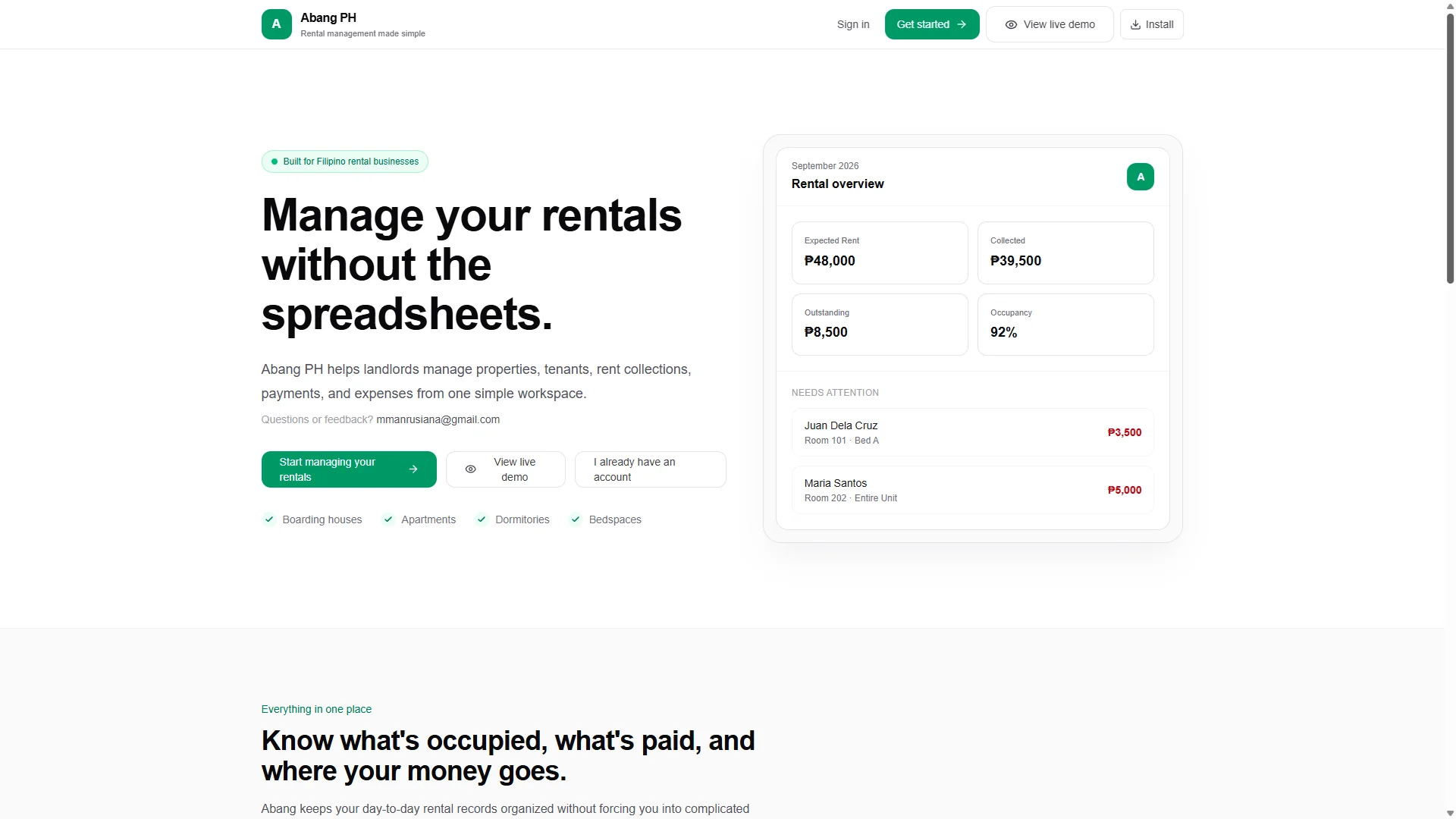
A rental management application designed to help landlords organize properties, tenants, rental payments, and everyday operations.
Category
Web Application
Project
Abang PH
Technologies
01 / Overview
The Story Behind the Project
Abang PH is a rental and property management web application designed for small landlords, boarding house operators, and property owners in the Philippines. It aims to simplify everyday rental operations by organizing properties, rentable spaces, tenants, rental payments, and financial records within a centralized system.
02 / The Problem
Understanding the Challenge
Small landlords often manage tenant information, rental payments, and property availability through notebooks, spreadsheets, or informal messaging. These disconnected processes can make it difficult to track outstanding balances, monitor occupied and vacant spaces, and maintain accurate financial records. The challenge was to design an accessible system that simplifies rental administration without introducing unnecessary complexity.
03 / The Approach
How We Approached It
Designed a full-stack web application using Next.js, TypeScript, Prisma, and PostgreSQL. The system models properties, units, rentable spaces, and rental records using structured database relationships. It incorporates authentication, landlord-specific data access, monetary calculations, and dashboard views to support the development of a reliable rental management platform.
04 / My Contributions
What I Worked On
- ↗Designed the initial full-stack architecture using Next.js App Router and TypeScript.
- ↗Created relational database models for properties, units, rentable spaces, and landlord accounts using Prisma.
- ↗Integrated authentication using Better Auth.
- ↗Implemented authorization checks to restrict property access to the associated landlord account.
- ↗Developed property and rentable-space management functionality.
- ↗Created monetary utility functions using integer-based cent calculations to avoid floating-point precision errors.
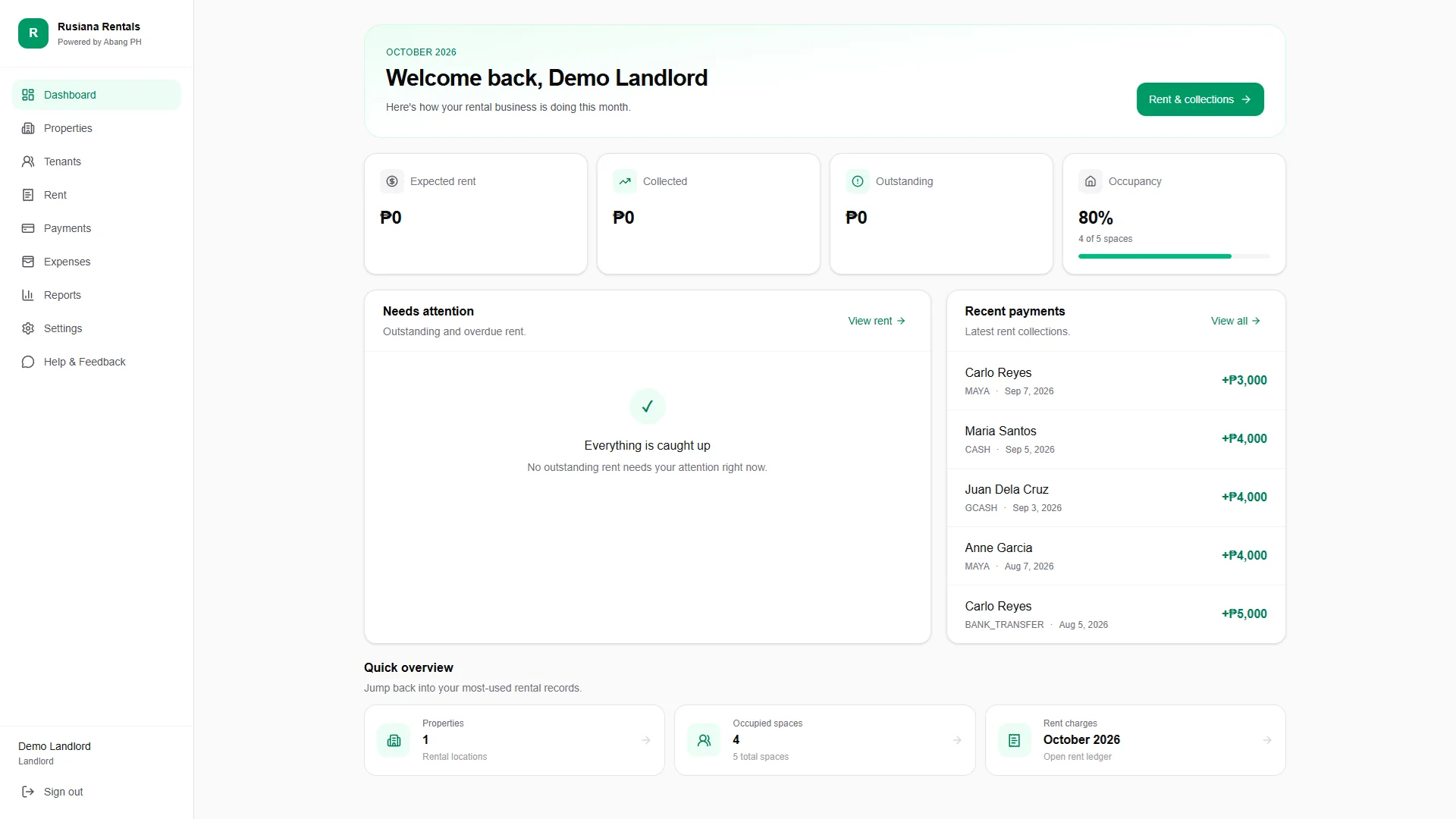
- ↗Built initial dashboard interfaces for rental statistics, occupancy information, and payment summaries.
- ↗Configured a PostgreSQL development environment using Docker.
- ↗Implemented development seed data representing properties, tenants, and rental payment scenarios.
05 / Engineering Challenges
Problems Worth Solving
- —Designing database relationships that accurately represent properties, units, and independently rentable spaces.
- —Ensuring landlords can only access and modify records belonging to their own accounts.
- —Handling authentication schema compatibility and database migration changes.
- —Representing monetary values safely without introducing floating-point rounding errors.
- —Managing relational queries while maintaining data isolation between different landlords.
- —Balancing flexible rental management requirements with a simple user experience.
06 / Lessons Learned
What This Project Taught Me
- ✳The importance of designing database relationships before implementing complex business workflows.
- ✳How authorization and tenant-specific data filtering protect sensitive application records.
- ✳Why financial applications should use precise monetary representations instead of floating-point arithmetic.
- ✳How Prisma migrations affect database integrity and why schema changes require careful review.
- ✳The differences between authentication, authorization, and data ownership.
- ✳How to structure reusable backend services with validation, security checks, and clear business responsibilities.